
Insulation contractors for Detroit's older homes
Spray Foam Insulation in Detroit, MI
Open-cell and closed-cell foam, blown-in walls and attics, and air sealing for houses built before anyone thought about drafts.
- Free on-site look before any price
- Written quote with foam type, thickness and R-value by area
- Moisture, knob-and-tube and leaks flagged before anything gets covered
Warmer Winters Start at the Leaks
Spray foam insulation in Detroit is mostly about older houses. The city was founded in 1701, peaked at about 1.85 million residents in 1950, and still has one of the largest surviving collections of late 19th and early 20th century buildings in the country, including blocks of pre-war wood-frame and brick houses. Few of those were built with air sealing in mind. We insulate and seal attics, walls, basements and rim joists across Detroit and its suburbs, using open-cell or closed-cell spray foam where it is the right tool and blown-in insulation where that does the job for less.
What a Detroit winter asks of a house
Wikipedia's 1991-2020 table for Detroit Metro Airport lists a January average high of 32.3F and an average low of 19.2F, about 45 inches of snow a year, and a record low of -21F. The average freeze window runs from about October 20 to April 22. That is half the year with heat running, and every gap at the top and bottom of the house costs money the whole time. Warm air rises out through attic bypasses and pulls cold air in at the rim joist and basement. Seal both ends and the drafts, cold floors and ice dams usually ease together.
Summer matters too. The city has a hot-summer humid continental climate, so the same attic that leaks heat in January cooks the upstairs in July. A sealed, well-insulated attic helps in both seasons.
What the code expects here
Michigan's energy code puts Wayne, Oakland and Macomb counties in Climate Zone 5A. The prescriptive table in the residential energy code that has been in force (the 2015 Michigan edition, which Troy's building department notes stays in effect while the 2021 residential code is paused) lists R-38 for ceilings, R-20 or R-13 plus R-5 continuous for wood-frame walls, R-10 continuous or R-13 cavity for basement walls, and R-30 for floors. The Department of Energy recommends going further in an existing Zone 5 attic: R-60 when the attic is bare, or adding R-49 on top of 3 to 4 inches already there. Michigan's residential code also sets footings at 42 inches below grade, which tells you how deep the cold goes around a basement.
Closed cell vs open cell
Open-cell foam is soft and light. It expands to fill odd cavities and stops air movement, but it lets some water vapor pass, and it runs about R-3.5 to R-3.7 per inch according to HomeGuide. Closed-cell foam is dense and rigid, about R-5 to R-7 per inch, and at normal thickness it acts as a vapor retarder and does not soak up water. In Detroit that makes closed-cell the usual pick for rim joists, basement walls, the underside of floors over garages and any roof deck that has no room for venting. Open-cell often fits interior walls, sound control and roof lines with enough depth. We tell you which one we would use for each area and why.
When foam is not the answer
Spray foam is not the cheapest way to insulate a wide-open attic floor. On most Detroit attics with good access, we seal the leaks first with foam and caulk, then blow cellulose or fiberglass to depth. Foam earns its price where the space is tight, oddly shaped, damp or needs an air barrier and insulation in one step. The quote will say which approach we picked for each space.
Spray foam insulation cost
HomeGuide's 2026 guide puts installed spray foam at about $1.50 to $5.00 per square foot, with open-cell around $1.50 to $3.50 and closed-cell around $3.00 to $5.00. Whole-house projects run about $8,000 to $20,000 in HomeGuide's figures and $10,000 to $30,000 in Fixr's. Small jobs often hit a minimum of $1,000 to $2,000 or more. Those are national ranges; your price is the one on the written estimate, after we have measured.
If DTE supplies your heat, its 2026 insulation rebate page lists $600 for roof and attic insulation (500 square foot minimum), $125 for above-grade walls, and $50 each for rim joists, basement walls, crawl space walls and floors. Funds are first come, first served, so check the page before you plan around a rebate.
Choosing among spray foam insulation companies
When you compare spray foam insulation contractors near you, ask each one the same questions. Which foam goes where, and how thick? What R-value will each area reach? What gets sealed before anything is covered? How long should you stay out of the house during curing (HomeGuide notes 24 hours or more is common)? Will the quote be itemized? Insulation companies that answer those plainly, in writing, make it easy to compare. We put those answers on every quote. Get a free estimate
Where We Work
We work in Detroit and the suburbs around it. In Wayne County that includes Dearborn, Dearborn Heights, Livonia, Westland, Hamtramck and Wyandotte. In Oakland County it includes Southfield, Royal Oak, Ferndale, Troy and Novi. In Macomb County and the Pointes it includes Warren, Sterling Heights, St. Clair Shores and Grosse Pointe Woods. The housing changes a lot across that ring. Hamtramck grew more than tenfold between 1910 and 1920 and is the most densely populated city in Michigan. Ferndale did most of its housing growth between 1920 and 1951, and southeast Warren is largely post-war bungalows. Livonia, Westland and Sterling Heights grew out of farm townships after World War II. Novi, a city only since 1969, is newer still. Each town page covers what is different about the homes there.
- Spray Foam Insulation in Detroit, MI
- Spray Foam Insulation in Dearborn, MI
- Spray Foam Insulation in Dearborn Heights, MI
- Spray Foam Insulation in Livonia, MI
- Spray Foam Insulation in Westland, MI
- Spray Foam Insulation in Southfield, MI
- Spray Foam Insulation in Royal Oak, MI
- Spray Foam Insulation in Ferndale, MI
- Spray Foam Insulation in Troy, MI
- Spray Foam Insulation in Warren, MI
- Spray Foam Insulation in Sterling Heights, MI
- Spray Foam Insulation in St. Clair Shores, MI
- Spray Foam Insulation in Grosse Pointe Woods, MI
- Spray Foam Insulation in Hamtramck, MI
- Spray Foam Insulation in Wyandotte, MI
- Spray Foam Insulation in Novi, MI
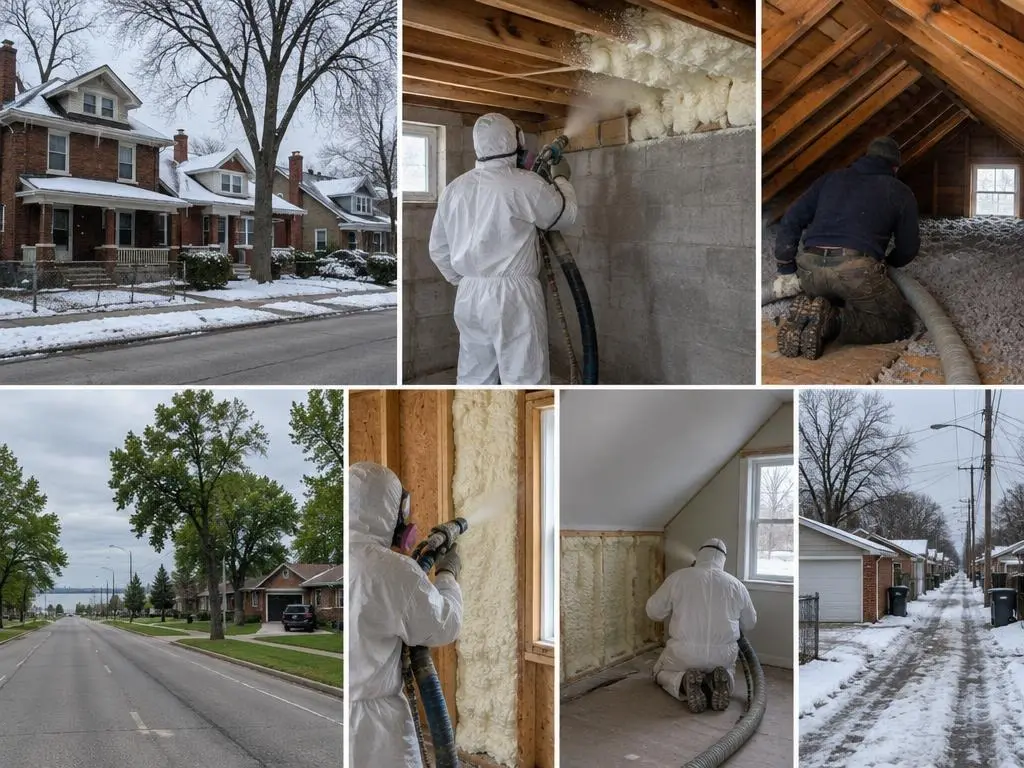
Why Homeowners Call Spray Foam Insulation Detroit
We look before we price
Every quote follows a visit to the attic, basement and walls. No phone guesses.
Seal first, then insulate
Bypasses, top plates, flues and the rim joist get sealed before new insulation hides them.
Foam only where it pays
Closed-cell, open-cell, cellulose or fiberglass, chosen per area with the reason written down.
Old-house problems flagged
Knob-and-tube wiring, possible vermiculite, roof leaks and damp sills get pointed out before we cover anything.
Rebate-ready paperwork
Quotes list each area and its square footage, which is what DTE's insulation rebate form asks about.
Common Questions
How much does it cost to spray foam a 2,000 sq ft house?
It depends on what gets foamed. A house that size rarely needs foam on every surface. National guides put whole-house spray foam at about $8,000 to $20,000 (HomeGuide) or $10,000 to $30,000 (Fixr). Most Detroit homes get better value from foam in a few key spots, like the rim joist, kneewalls and roof deck areas, plus blown-in insulation elsewhere.
How much does spray foam insulation usually cost per square foot?
HomeGuide lists about $1.50 to $3.50 per square foot for open-cell and $3.00 to $5.00 for closed-cell, installed. Thickness drives the price, so a 5-inch roof deck costs more per square foot than a 2-inch rim joist. Your written estimate is the number you pay.
Why do some people call spray foam a red flag?
Most concerns trace back to poor installs: foam sprayed onto a roof deck that hides a leak or rotting sheathing, or foam mixed or applied wrong that leaves an odor. Foam that is planned for the space, applied at the right thickness and left to cure properly does not have those problems. We check for leaks and moisture first and write down what was installed where.
Is it hard to sell a house with spray foam insulation?
Some buyers and inspectors ask more questions about foam on the underside of a roof, because it makes the decking harder to inspect. Keeping your quote and invoice, with the product, thickness and areas listed, gives a future buyer real answers. Foam on rim joists and basement walls rarely raises questions.
Is there free spray foam insulation in Detroit?
We do not offer free foam, and we would be wary of anyone who does. What does exist is DTE's insulation rebate program for customers whose heat DTE provides, which lists set amounts per area. Check DTE's current page for amounts and deadlines.
Should I insulate the attic or the basement first?
If the budget only covers one, the attic usually comes first because warm air escapes upward and the attic floor holds the biggest leaks. The rim joist is a close second and costs much less. We often do both on the same visit, since sealing both ends is what stops the draft through the house.
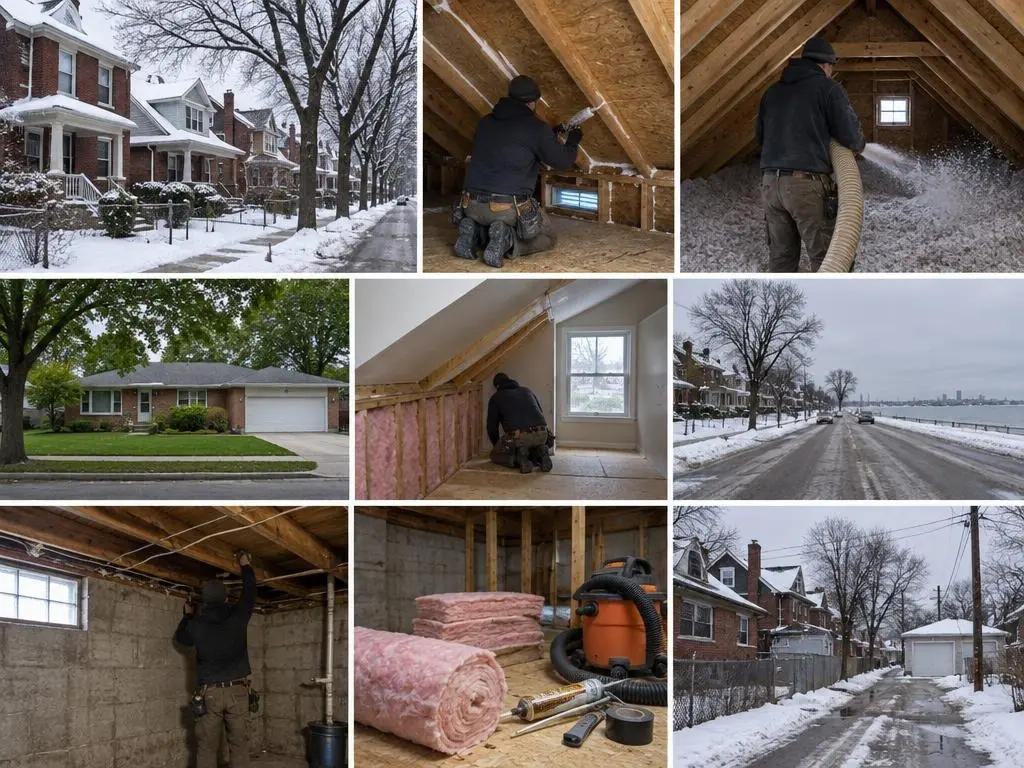
Insulation Services
Six kinds of work we do in Detroit-area homes, from the attic down to the rim joist.
Spray Foam Insulation
Open-cell or closed-cell foam sprayed where it does the most good: rim joists, roof decks, kneewalls and walls.
Learn more →Attic Insulation & Air Sealing
Attic bypasses sealed, then insulation added to the depth a Michigan attic needs.
Learn more →Basement & Rim Joist Insulation
Closed-cell foam on rim joists and basement walls to stop drafts at the bottom of the house.
Learn more →Wall Insulation for Older Homes
Dense-pack cellulose or injection foam blown into closed walls, with no full tear-out.
Learn more →Bungalow & Kneewall Insulation
Sealing and insulating the kneewalls, slopes and attic floors of story-and-a-half homes.
Learn more →Insulation Removal & Replacement
Old, wet, dirty or rodent-damaged insulation vacuumed out so the attic can be sealed and refilled.
Learn more →Get a Spray Foam Insulation Estimate
Free visit, written quote, and a straight answer on whether foam is worth it for your space.